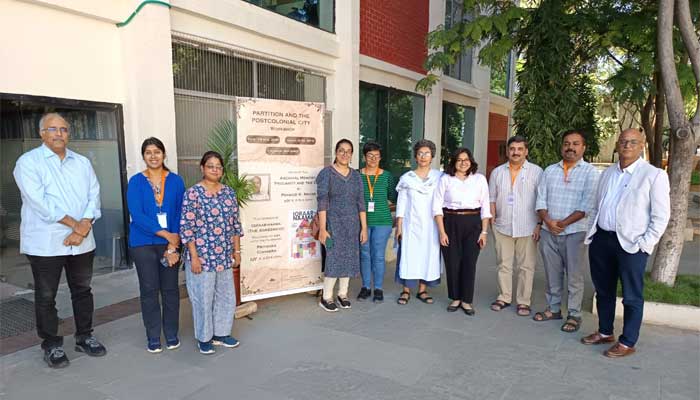
Isha Dubey from the Human Sciences Research Centre organised a workshop on the theme of Partition and the Postcolonial City on November 7-8. A part of her seed grant project Partition and the Postcolonial Metropolis: Migration, memory and urbanism in post-1947 Bombay, the workshop explored the interlinkages between the partition of the Indian Subcontinent in 1947 and the ways in which it has shaped the constitution of urban space and cultures in Indian cities – both big and small. The workshop had participants from diverse disciplines and overlapping fields of history, sociology, literature, urban studies, memory studies, culture studies and film studies present their work focusing on cities such as Bombay, Kolkata, Delhi, Hyderabad, Nadia, Gandhidham, Purnia, Patna and Aligarh among others and the impact that the partition had on them. In doing so, the papers presented and the discussions around them dwelled on a range questions: How did older neighbourhoods change and shift to make way for those who came from across the borders to settle in them? What kinds of new settlements came up to accommodate the incoming refugees and how have they developed into new localities through the post-Partition years? What impact did the partition have on the demographics and patterns of land ownership in the cities and how did this in turn influence urban culture and power dynamics therein? To what extent can later histories of both inter-communal conflict and cooperation be linked to and evoke memories of the Partition in postcolonial South Asian cities? The format followed was that of a closed and intensive workshop wherein the first drafts of the papers presented were circulated among the participants prior to the event with the aim of providing them with focused feedback that can be used for preparing them for eventual publication.
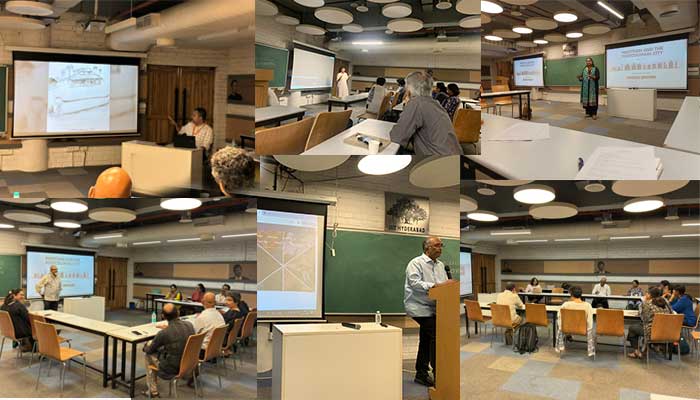
Apart from the closed workshop, the event also featured a keynote talk by Prof. Pramod Nayar (Central University of Hyderabad) titled Archival Memory, Precarity and the City and a public screening of the documentary Iqraar-naama by Delhi-Based film maker Priyanka Chhabra who was also present for an insightful and engaging Q&A session with the audience thereafter. Both the talk and the screening brought up important and timely questions about the (changing) nature and registers of historical archives, digitisation, modes of remembrance and forgetting facilitated and mediated by technology and the processes of re-making of urban space and the heritage discourse.
To know more about the workshop please visit: https://hsrc.iiit.ac.in/partition-and-postcolonial/
November 2025