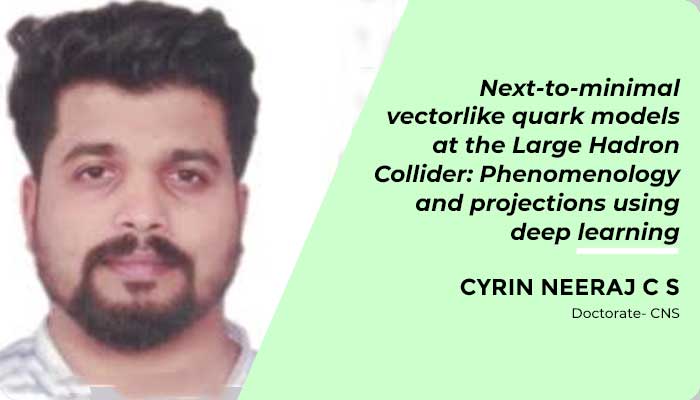
Cyrin Neeraj C S supervised by Dr. Subhadip Mitra received his doctorate in Computational Natural Sciences (CNS). Here’s a summary of his research work on Next-to-minimal vector-like quark models at the Large Hadron Collider: Phenomenology and projections using deep learning:
Despite the success of the Standard Model (SM), the absence of new physics signals at the Large Hadron Collider (LHC) motivates the exploration of Beyond the SM (BSM) scenarios that deviate from minimal assumptions. Searches for TeV-scale vector-like quarks (VLQs), a common feature in many BSM frameworks, are generally assumed to decay through SM bosons, leading to stringent model-dependent mass limits. In this thesis, we discuss the phenomenology of next-to-minimal VLQ models where this assumption is relaxed, allowing for dominant decays into a new SM-singlet scalar or pseudoscalar state (Φ). First, we present the theoretical motivations for such extensions, demonstrating their potential to address fundamental issues like the strong CP problem and Higgs vacuum stability and their natural emergence within frameworks such as Two-Higgs-Doublet and Composite Higgs models. Then, a bottom-up phenomenological framework for singlet and doublet VLQs containing top and bottom partners is developed. By reinterpreting current experimental constraints from the LHC, we see that a vast viable parameter space for these exotic decays remains open without requiring significant fine-tuning. Finally, detailed collider analyses of VLQ pair production are presented using the complete LHC simulation chain to assess the discovery potential at future LHC runs. We use advanced machine learning techniques to distinguish signals from substantial SM backgrounds in several challenging final states. Specifically, this work evaluates prospects for three signatures with different ML models: 1) mono-leptonic final states from single t𝑇-quark pair-production using boosted decision trees; 2) mono-leptonic signatures from singlet 𝐵-quark pair-production via mixed decays, analysed with a deep neural network model; and 3) fully hadronic final states from 𝐵-quark pair-production, where a novel graph neural network-based model is used to perform event-level classification. The results project a strong discovery potential for VLQs with masses extending well beyond current limits, providing a concrete roadmap for future experimental searches at the High-Luminosity LHC. This thesis underscores the critical synergy between BSM phenomenology and sophisticated machine learning in uncovering new physics in complex collider environments.
October 2025