
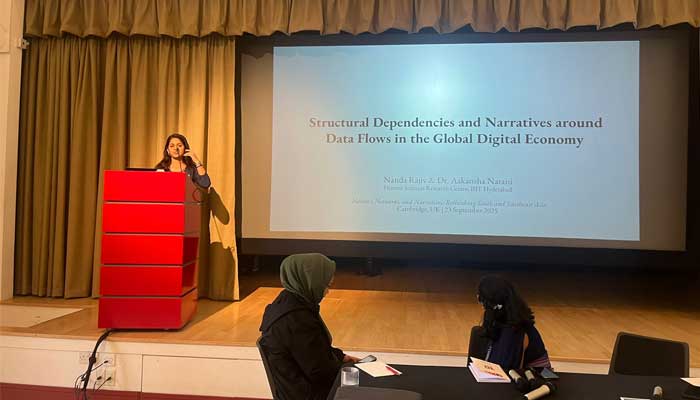
Nanda Rajiv, B.Tech and MS by Research in Computational and Human Sciences working with Dr. Aakansha Natani presented a paper on Structural Dependencies and Narratives around Data Flows in the Global Digital Economy at a conference – Nations, Networks, and Narratives: Rethinking South and Southeast Asia organised by the University of Cambridge, UK. The conference was held at Wolfson College, University of Cambridge, UK from 22 – 24 September. Here the summary of the paper as explained by Nanda Rajiv & Dr. Aakansha Natani:
Data is emerging as a crucial factor in international trade agreements, and its flow across borders is now an important economic process. This can be observed in three ways. First, there is a growing push for an open global digital economy by developed countries and big-tech platforms with free and non-restricted cross-border data flows This is highlighted by the Data Free Flow with Trust (DFFT) concept proposed by Japan in 2019, and supported by a bevy of advanced economies such as the G7 and many members of the G20. Second, many older trade agreements have been revisited and updated to account for cross-border data storage, transfer and processing, such as the NAFTA renegotiated as the USMCA, and EU FTAs being updated to account for digital trade, that prohibit the establishment of domestic localisation policy. Lastly, new agreements have emerged exclusively for digital trade, such as Digital Economy Agreements (DEAs), a notable one of which is the UK-Singapore DEA, 2022. Such frameworks advocate certain standards related to interoperability in data collection, storage, protection, transfer and provisions to guarantee consumers’ privacy. The key line of argument in these frameworks pushes for a ‘free and open’ digital economy for all. They are not just related to the same technical standards for data collection, but also cover legal and regulatory structures related to jurisdiction and dispute settlement across borders.
We highlight these legal, technical, and regulatory standards and argue that they set up a ‘structural dependency’ in the global digital economy. Countries that make up a greater share of the digital economy are at the helm of this global data governance system, and thus, determine the standards being set within it. To participate, countries located in the Global South must either incorporate these frameworks or make new ones that do not contradict with the established standards.
This paper seeks to analyse the normative statements made by key global actors around data free flow and data localisation. By identifying their characteristics and the actors that propagate them, we compare these arguments to locate differences between the Global North and Global South outlook on a global data economy.
With this, we get an understanding of the competing narratives around data free flow and localisation, which reflect geopolitical interests and asymmetries in digital capabilities. While the Global North mostly pushes for frameworks that support unrestricted data flows under the banner of openness and interoperability, the Global South often seeks greater control over its data as a means of asserting digital sovereignty. This divergence becomes increasingly important to observe as the implications of data flows and localisation grow more relevant, with the rapid proliferation of AI, and its dependence on data.
Conference page: – https://www.wolfson.cam.ac.uk/about/events/nations-narratives-and-networks-rethinking-south-and-southeast-asia
 September 2025