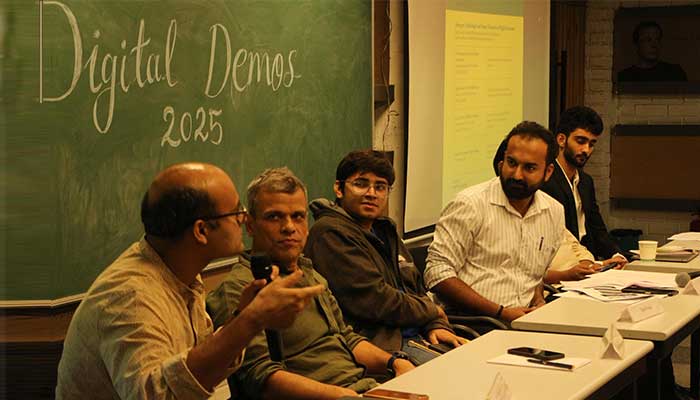
The Human Sciences Research Centre (HSRC) organised an International conference on Digital Demos: Data, Democracy and Regulations in the EU and India on 9 and 10 September. This was organised under the Jean Monnet Module on ‘Digital Democracy and Data Governance in the European Union’ in collaboration with IHub Data@IIIT Hyderabad and Department of Political Science, University of Hyderabad.
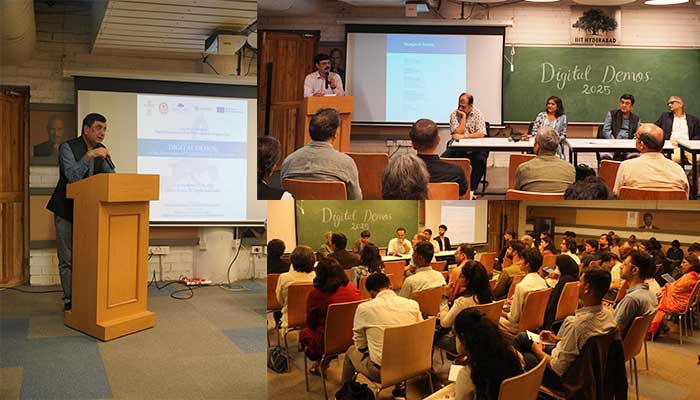
The conference began with a welcome address by Prof. Anirban Dasgupta, head of the Human Sciences Research Centre (HSRC). The conference convenor, Dr Aakansha Natani then laid out the goals, objectives and philosophy of the conference. The conference envisioned providing a platform for knowledge exchange on data governance and digital infrastructure, geopolitics of digital technology, and included five panels, four lightning talks, two keynote addresses.
Prof. Gulshan Sachdeva, Chief Coordinator, DAKSHIN – Global South Centre of Excellence at RIS Jean Monnet Chair and Professor Centre for European Studies, Jawaharlal Nehru University drew from his expertise over EU-India and spoke about the conditionally co-operative relationship between the two countries that saw multiple strategic partnerships between India and the EU as well as its constituent countries, while allowing for differences as well. His overview of the digital infrastructure and regulations in the two entities set the stage for the panels that followed. Arguing that the “EU has huge capacity to influence institutions of global economic governance”, he highlighted how the GDPR, a “solid comprehensive legal framework” has served as template for the development of rules and regulations by other countries across the world. He ended his speech by emphasising a need to examine tech and human relations within a broader geo-political landscape.
Prof. Balaji Parthasarathy, Department of Digital Humanities and Societal Systems, IIIT Bangalore, presented the keynote address on “Inclusion and exclusion in the multiple trajectories toward a digital India: the means and the modes”. Taking the participants to the 1970s, he pointed out how the hardware industry has by-passed India leading to the question – “Would India ever be included in the digital age?” The growth of India’s eventual engagement with the software industry was driven by the presence of “high skilled low-cost labour” to a software industry that was labour intensive and produced raw code export while importing the code embedded in goods and products. Speaking to the shifts in the 21st century he summarised the precarity of gig workers. He spoke about the shifts in platform operations that introduced tiers pushing gig workers to compete for slots. He ended his talk asking whether the state was abdicating its responsibility to the workers.
The talk was followed by a rich Q&A session covering the code of social security, the hesitation in thinking of workers, the platform’s struggles with onboarding workers, the platform – venture capital nexus.
The inaugural session ended with a vote of thanks by Dr. Shaji, co-convenor of the conference and associate professor, Department of Political Science, University of Hyderabad, India.
Prof. Shishir K Jha, Ashank Desai Centre for Policy Studies, IIT Bombay, then set the stage for the panels with his lightning talk on “private data, public value” arguing for exploring public benefits from using private data.
The first panel interrogated “Emergent Technologies and Future Trajectories of Digital Governance”. The speakers explored the ethical norms informing AI governance frameworks, the importance of building analysis consent architecture and dynamic consent, and a need for uniform compliance measures internationally for international businesses working with sensitive data across different countries.
The second panel covered cross border data flows, localisation, and digital sovereignty. The panelists covered questions of digital colonialism, the nuances that divide digital sovereignty and data nationalism, the revival of dependency theory in the interaction of data and “regulatory capitalism”.
The second lightning talk of the day was given by Prof. K Ravi Srinivas, adjunct professor at NALSAR University of Law and Associate Faculty Fellow with Centre for Responsible AI, IIT-Madras. Speaking on Digital Sovereignty: Rhetorics and reality, he pointed to the complexities surrounding datafication.
The third and last panel of the day included reflections on digital frontiers and theoretical explorations and grappled with questions of sovereignty. The panelists looked at online extremism, decolonisation, social contract and hybrid warfare disorder in India and EU.
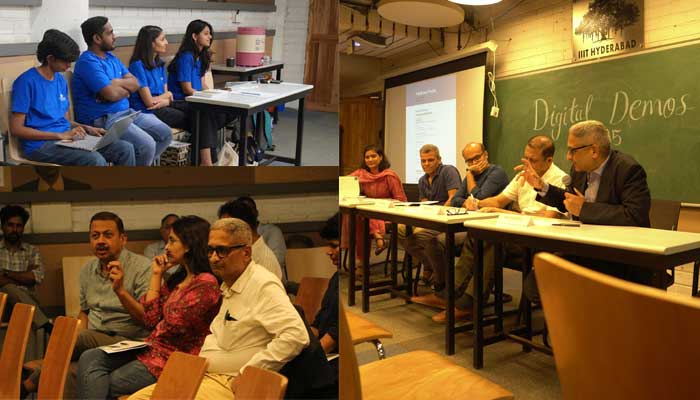 The second day of the conference included two panels, two lightning talks, a keynote address, and a valedictorian session to bring the conference to a close and reflect on where future research lies.
The first panel of the day reflected on digital governance regimes, institutions, and infrastructures. The scope of presentations ranged from urban digital public infrastructure to comparative analysis of data rights and regulations in the EU and India to a structural and functional evaluation of data democracy in the EU.
The panel was followed by a lightning talk by Prof. Pradip Thomas from The University of Queensland, Australia, who presented his observations on Data Governance in Theory and in Practice. His talk was centred around the entanglements of the State with big tech. He argued that these entanglements made states less likely to write regulatory policy. He also remarked that companies were participating in data governance with or without state support.
The last panel of the conference investigated digital principles and rights. Panelists spoke on subversion, satire and online expression as tools for engaging with digital human rights along with conceptions of algorithmic life of citizenship, the paradox of digital participation, and the democratic dilemma emerging from the interaction of caste, gender with digital rights.
The second keynote address of the conference was presented by Prof. Ingrid Schneider of the Department of Informatics, University of Hamburg, Germany. Her speech began by recognising “a new era of multi-polarity” where digital technology has become a central arena of digital competition. Commenting on the geo-politics that inform data and privacy regulations, she highlighted the manner in which the unilateral imposition of tariffs was being employed by the USA to demand a weakening of digital regulations. At the same time, she noted, resistance to the US was emerging from the rise of China’s AI catching up, the shift in the approximation between India and USA as India forms alignments with BRICS. Pointing to the differences between Europe and India’s data privacy regulations, she remarked that the GDPR was based on privacy as a fundamental right whereas in India, the DPDP Act was more procedural in nature and did not impose limits on collection, nor include the concept of deemed consent. Commenting on narratives on AI in India, she highlighted the nature of India’s AI policy to promote “AI for all, AI for good” while downplaying the risks emerging from bias. She identified India’s DPI as the basis of India’s data economy, arguing also that “DPIs are sold as India’s export model to the world.” She also engaged with the question of whether DPI is public, private, or a tool for privatisation?
The last lightning talk was presented by Tanveer Hasan, Executive Director, Centre for Internet and Society, who spoke on digital commons and the politics of open access. He identified commons and open-access as important infrastructures that should be non-antagonistic. He also highlighted the volume of the work that goes behind producing commons saying “visibility does not equal sustainability.”
The valedictory session began with a speech by Prof. K K Kailash, Head, Department of Political Science, University of Hyderabad, setting the agenda for the next panel discussion, speaking about how digital public has conceptually transformed over time and how, in the guise of openness there are a lot of imbalances perpetrated. The panel session was moderated by Dr. Aakansha Natani, and included Dr. Praveen Priyadarshi, Assistant Professor of Politics, IIIT Delhi, Dr. Manohar Kumar, Assistant Professor, IIIT Delhi, Prof. Shishir K Jha, Ashank Desai Centre for Policy Studies, IIT Bombay, and Prof. Balaji Parthasarathy, Department of Digital Humanities and Societal Systems, IIIT Bangalore, as panelists. They spoke about moments of technological transformation and the emergence of different types of publics. They also evaluate events that led to forms of public there are uncertain, and moments where no public emerged, as well as the fragmentation of the public that is occurring at the cost of convenience of services, and how technology could become a replacement of politics. Addressing young researchers at the conference, the panelist emphasised the importance of understanding technology, technical concepts, collaborating with computer science departments, to contest the concepts made normative by technology, and to root their inquiry in “What bothers you?”
The conference ended with a vote of thanks by Dr. Shaji who highlighted the richness of the presentations, and the discourse that followed.
September 2025