
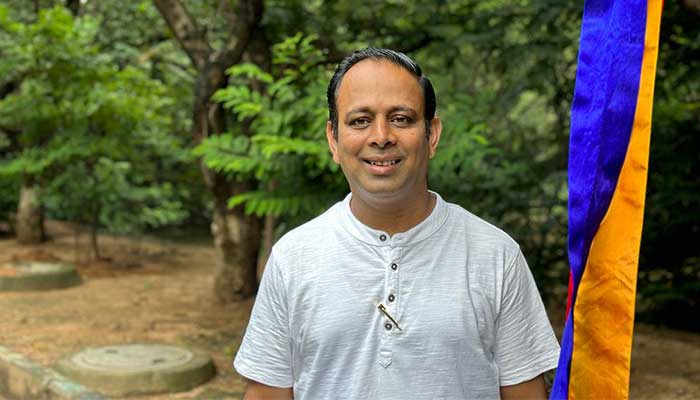
Dr. Sujit Prakash Gujar gave the following two talks:
IIT Gandhinagar
Dr. Sujit Prakash Gujar gave a talk on Fair distribution of MEV in blockchains through Shapley Value at IIT Gandhinagar. Here is the summary of the talk as explained by Dr. Sujit Prakash Gujar:
In blockchains, by simply rearranging transactions or leveraging opportunities across multiple exchanges, a miner can extract more value than just collecting block rewards and transaction fees. This additional value is known as Maximal Extractable Value (MEV) (formerly referred to as Miner Extractable Value). However, extracting MEV requires additional resources and has given rise—especially in blockchain markets like Ethereum—to entities called builders. A builder collects publicly known transactions as well as transactions purchased from wallet service providers and constructs blocks designed to maximize MEV extraction. Such extraction amounts to millions of dollars annually.
This gives rise to two key questions:
- Do builders receive fair compensation for their work?
- Do transaction creators receive any reward for their transactions generating MEV?
In this talk, we show that a cooperative game theory approach is better suited to model this situation. For the first question, we demonstrate that the Shapley value can enhance fairness in the system and that a cooperative approach can yield higher MEV extraction than traditional competitive methods. While computing the Shapley value is generally computationally challenging, we derive a closed-form solution that runs in polynomial time.
For the second question, we model a separate cooperative game based on the revenue generated, involving wallet service providers and transaction creators. If builders’ valuations are additive, one can easily deduce that the Shapley values of the transactions. However, we conjecture that if valuations are single-minded, then computing the Shapley value becomes a SUBEXP problem. To address this, we present a simple sampling algorithm with PAC (Probably Approximately Correct) guarantees for approximating Shapley values.
Infosys Techzooka
Dr. Sujit Prakash Gujar gave a talk on Towards Building Ethical AI Through Fairness and Privacy at Infosys Techzooka. Here is the summary of the talk as explained by Dr. Sujit Prakash Gujar:
Deep Learning (DL) finds application in several prominent fields, including computer vision, natural language processing, and bioinformatics. The proliferation of DL-based methods (Gen-AI) has brought light to critical issues of bias (or unfairness) in classification and weak privacy guarantees for training data. It is crucial to prioritize addressing these issues to prevent the potentially significant negative impact on users. The talk is aimed at providing an exhaustive discussion on
(i) reasons behind unfair classifications and lack of privacy,
(ii) fairness notions in literature and methods to ensure them,
(iii) differentially private machine learning, and
(iv) algorithms that address fair and private machine learning simultaneously.
December 2025