
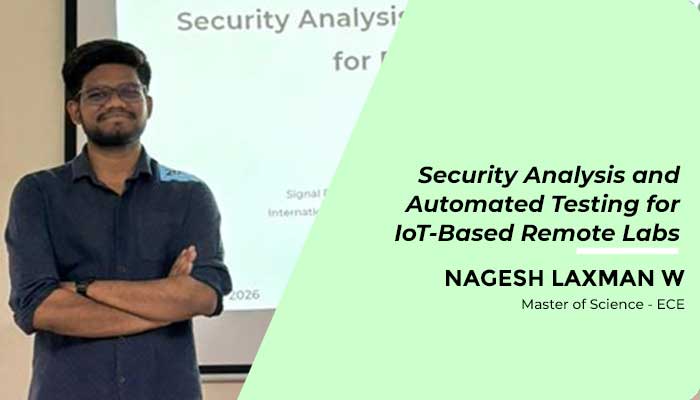
Nagesh Laxman Walchatwar supervised by Dr. Sachin Chaudhari received his Master of Science in Electronics and Communication Engineering (ECE). Here’s a summary of his research work on Security Analysis and Automated Testing for IoT-Based Remote Labs:
Remote laboratories have emerged as a critical component of modern engineering education by enabling students to perform hands-on experiments on real hardware from any location. However, building reliable and secure IoT-driven remote labs at scale remains challenging due to heterogeneous hardware, distributed communication channels, cloud dependencies, and continuous operational requirements. This thesis addresses two fundamental aspects essential for maintaining dependable remote experimentation at IIIT Hyderabad’s RLabs platform: security analysis of IoT-based remote labs and automated experiment readiness testing using computer vision. This thesis addresses these gaps through a systematic security assessment of the RLabs ecosystem by analysing vulnerabilities across device firmware, network protocols, interoperability layers, and web-facing components. The study identifies common IoT weaknesses—such as insecure communication paths, weak authentication, and unsafe hardware actuation pathways—and documents their relevance in the context of educational remote labs. The resulting threat model highlights risks related to hardware misuse, unauthorised control, and data exposure, offering practical mitigation strategies for strengthening system resilience. The second part introduces an automated testing framework designed to eliminate manual validation of experiment nodes. The system emulates real user interaction through scripted workflows and verifies hardware behaviour using a computer-vision pipeline tailored for each experiment. Integrated into GitHub Actions, the framework supports continuous testing, early fault detection, and automated reporting. Evaluations conducted on the Vanishing Rod and Focal Length experiments demonstrate that the testing pipeline can reliably identify hardware faults, misalignment, incorrect actuation responses, and degraded video feeds within minutes. Together, the security analysis and automated testing system significantly enhance the reliability, maintainability, and safety of remote laboratories. The thesis establishes a foundation for scalable deployments and paves the way for future extensions involving machine learning–based anomaly detection, intelligent fault prediction, and autonomous experiment calibration.
May 2026